Showing posts with label Button Mushroom Cultivation. Show all posts

Sunday, 1 July 2012

How to Grow Button Mushroom in India- Indian Method to cultivate Mushrooms.


BUTTON MUSHROOM

The cultivated mushroom is grown on special composts, which are of the following two types, synthetic and natural.

Composting yard
The compost should be prepared on well cleaned concrete or pucca floor, which should be at a higher level so that the run-off water does not collect near the heap.Composting is usually done in the open, but it has to be protected from rain by covering it with polythene sheet. It can also be done in a shed with open sides or a large room to shelter it from rain.

1. Synthetic compost
The following ingredients are required for 15-16 trays of size 100cmx50cmx15cm:-

Wheat straw (chopped 8-20cm long)-250kg, Wheat/rice bran-20kg, Ammonium sulphate/calcium ammonium nitrate-3 kg, Urea-3kg, Gypsum-20kg

The straw is uniformly spread over the compo sting yard in a thin layer and wetted thoroughly by sprinkling water. All ingredients such as wheat bran, fertilizers, etc. except gypsum, are mixed thoroughly in the wetted straw, which is finally heaped into a pile. The pile, 1m high, 1m wide and length adjustable, can be made with hand or stack mould. The straw should be firmly but not compactly compressed into the mould.

It is essential to open the entire pile and remake it a number of times according to the following schedule:

Mixing of material and making pile - 0 day
1st turning - 4th day
2nd turning - 8th day
3rd turning - 12th day, add 10 kg gypsum
4th turning - 16th day, add 10 kg gypsum
Final turning - 20th day,spray 10 ml malathion in 5 litre water (any other available pesticide like DOT, BHC, lindane can also be used)

At each turning water should be sprinkled to make up the loss of water due to evaporation. If it is desired to add molasses, then 10 kg molasses diluted 20 times with water should be poured over the straw mixture during the first turning. Sixty kg chicken manure, if available, can also be added at the time of start of pile.

2. Natural compost
The following ingredients are required for 15-16 trays of size 100cmx50cmx15cm:-

Horse dung-1000kg, Chopped wheat straw-300 to 350kg, Gypsum-25kg Poultry manure-100 to 110kg (or 3kg urea).

It is prepared from pure horse dung (dung of other animals should not be admixed), which must be freshly collected and should not have been exposed to rain. Chopped wheat straw is mixed with horse dung, urea or poultry manure. The mixture is uniformly spread over the compo sting yard and water is sprinkled over it so that the straw becomes sufficiently wet. The manure is then heaped in a pile as for synthetic compost. After 3 days when the manure in the heap gets heated up due to fermentation and gives off an odour of ammonia it is opened. The process is repeated 3 or 4 times after an interval of 3-4 days. Twenty five kg gypsum per tonne is added in two instalments at the 3rd and 4th turning. At the final turning 10 ml malathion diluted in 5 litres of water is sprayed into the manure.

Compost Filling in trays:
The compost when ready for fil1ing and spawning has a dark brown colour and no trace of ammonia. There is no unpleasant odour but it smells like fresh hay. The pH is neutral or near neutral. The compost should not be too dry or too wet at the time of filling in the trays, which can be determined by the palm test. For this purpose a small quantity of compost is taken into the hand and pressed lightly, if a few drops of water ooze out of the fingers then it is of right consistency. If relatively dry then the water should be made up by sprinkling. If too wet, the excess water should be allowed to evaporate. The prepared compost is now filled in trays, which may be of any convenient size but depth should be 15-18 cm. A standard size of tray is 100 cm x 50 cm x 15 cm. The trays should be made of soft wood and provided with the pegs at the four corners so that they can be stacked one over the other leaving sufficient space (15 cm) between the two trays for various operations. The trays are completely filled with the compost, lightly compressed and the surface levelled.

Spawning
Spawning means sowing the beds with the mycelium (spawn) of the mushroom. Spawn can be obtained from Mushroom Laboratory, Y. S. Parmar University, Chambaghat, Solan; National Mushroom Research and Training Centre, Chambaghat, Solan (H.P.) at a nominal cost. Small quantity of spawn is also available from the Division of Mycology and Plant Pathology, Indian Agricultural Research Institute, New Delhi. The grain spawn is scattered on the surface of the tray bed which is covered with a thin layer of compost. Spawning can also be done by mixing the spawn with compost before filling it in trays. Five hundred gram spawn is sufficient for five trays of standard size. After spawning, the compost surface is covered with old newspaper sheets, which are wetted by sprinkling water to provide humidity but no water is directly added to the compost during spawn running.

The trays after spawning are stacked vertically one over the other in 4-5 tiers. One metre clear space may be left in between the top tray and ceiling. There should be about 15-20 cm space between the two trays.

The room should be maintained around 25°c. The humidity should be built up by frequently watering the floor and walls. The room may be kept closed as no fresh air is needed during the spawn run. White cottony mycelium spreads and permeates through the compost. Eventually the compost surface gets covered with the mycelium. It takes 12-15 days for complete spawn run. Low temperature prolongs the spread of the mycelium.

Casing
After the spawn run is complete as is evident by white cottony growth, the surface of the compost is covered with 3 em layer of casing soil. A suitable casing soil can be prepared by mixing equal parts of well rotten cowdung (finely crushed and coarsely sieved) and garden soil. The casing material should possess high water holding capacity, good pore space and pH should not be lower than 7.4. The casing material is sterilized to kill insects, nematodes and molds. Sterilization can be accomplished either by steaming or by treating with formalin solution. For one cubic metre of casing soil, hqlf litre for formalin (40%) diluted with 10 litre of water is sufficient. The casing soil is spread over a plastic sheet and treated with formalin by sprinkling. The treated soil is piled up in a heap and covered with another plastic sheet for 48 hours. The soil is turned frequently for about a week to remove all traces of formalin which can be tested by smelling. After casing, the temperature of the room is maintained at 25°C for further three days, after which it must be lowered to below 18°C. At this stage lot of fresh air is needed and, therefore, the growing room should be ventilated by opening windows etc.

Cropping and HalVesting
The first flush of the pin heads become visible 15-20 days after casing or 35-40 days after spawning. Small white buttons develop 5-6 days after pin head stage. The right stage of harvest is when the caps are still tight over the short stem. In case the buttons are allowed to mature further, the membrane below the cap will rupture and the cap will open up in umbrella-like shape. Such mushrooms are considered to be inferior. Harvesting is done by holding the cap with forefingers slightly pressed against the soil and twisting it off. The soil particles and mycelial threads clinging to the base of the stalk are chopped off. Mushroom can also be harvested by cutting off with a sharp knife at soil level.

Yield
The average yield of 3-4 kg per tray is considered normal. However, if compost is carefully prepared, spawn is reliable and temperature is favourable, then a yield of 5-6 kg per tray is possible. Partial or complete failure may also happen due to negligence.

Storage
The mushrooms are best consumed fresh. Storage in refrigerator for a few days is possible if they are placed between moist paper towel.

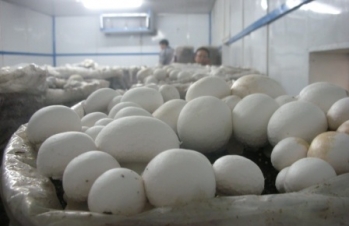
Button Mushroom Cultivation in Sikkim

In Sikkim it was 1970 when the Department of Agriculture took the initiative of  cultivation of button mushroom. Research and trail in this sector was started by the department. In the year 2003 with the built up of a small Mushroom Unit at Marchak, Ranipool, the Button mushroom cultivation on commercial basis was started but again due to the upcoming of Agriculture Engineering College in the year 2006 this Mushroom section was immediately shifted to the I. P. M. Laboratory at I. C. A. R. Complex Tadong. Now, after a gap of five and a half years the Department of Horticulture and Cash Crop Development Department has succeeded in producing Organic Button Mushroom on commercial basis at Majhitar which has started fruiting from 15th of January 2012.

Mushrooms belong to a separate group of organisms called Fungi. They lack  green matter (chrolophyll) present in the plants and grow on dead and decaying organic materials. They absorb their nutrition from these decaying substrates with the help of very fine thread like structures (mycelium) which penetrate into the substratum and are generally not visible on the surface. After the mycelium has grown profusely and absorb sufficient food materials, it forms the reproductive structure which comes out of substrate and forms fruiting body, commonly known as MUSHROOM.

Types of Mushroom -  At present 3 types of mushrooms are being cultivated.
  1. Button mushroom (Agaricus bisporus)
  2. Paddy straw mushroom (Volvariella volvacea)
  3. Oyster mushroom (Pleurotus sajor – caju)
Agaricus bisporus is the most popular and economically sound to grow and is extensively cultivated throughout the world. However, due to its low temperature requirement during fruiting, its cultivation is restricted to the cool climatic areas.

Yearwise production schedule –
Mid November to Mid March – Agaricus bisporus
Feb to Mid April – Pleurotus sajor- caju
Mid June to Mid September – Volvariella volvacea.
September to November – Pleurotus sajor – caju.

Mushroom poisoning – There are three types of mushroom poisoning depending upon the toxic principle present-
  1. 1. Muscarine type, (due to inocybe and related species known as early mushroom poisoning)
  2. 2. Hallucinogenic, ( due to A. muscaria species)
  3. 3. Phalloidin type, ( due to A. phalloides and its related species, known as late mushroom poisoning) Mushroom poisoning is also known as mycetism. Fatality due to mushroom consumption is common among poverty ridden families. As such there is no particular features to differentiate between poisonous and non poisonous mushrooms.
The Mushroom section of Horticulture and Cash Crop Development has produced 7 metric tones of Compost for button mushroom which is spawned by thorough spawning method. This process has started from 15th of November 2011 on trial basis and fruiting started exactly after two months i.e. 15th of January 2012 as per the formulations and the process  mentioned below.

Wheat Straw                                -     Base Material
Chicken/ Horse Manure             -     For activating Formulations
Wheat Bran                                 –     Hasten the composting process to       balance C:N ratio.
Gypsum                                        -     Neutralize Greasiness.
Cotton seed meal                         -     N2 Quick growth of microbial    population.


15.11.11 ——-         PHASE-I     (Out door  Composting)

PHASE-II                                    (Pasteurization & Conditioning)

18.11.11 ———                           For 4 days – Pre wetting of W/Straw with water in composting yard.

5th day   -                                      Add Chicken / Horse Manure + Wheat bran + Cotton seed Meal

21.11.11 —–               0 Day                      (7th day)     -  Pile making/ Stacking upto 5 ‘(60 .C)

23.11.11 ——          + 2 Day                     ( 9th day )   -   1st turning of Pile (70 .C)

25.11.11  ——-       + 4 Day                      (11th day)   –   2nd turning of Pile (75 .C)

27.11.11 ——-        + 6 Day                      ( 13th day)  -   3rd turning of Pile (Add Gypsum)
29.11.11  -  4.12.11     PHASE-II               ( 15thday)   –  Compost filling in Pasteurizing Chamber as   quickly as possible  and close the door air tight & live steam injected for 6-8 hours at 58 .C then conditioning starts for  5-6 days ( 45 – 52 .C)


05.12.11-15.11.11          20th day (for 10 days)-       Compost ready for spawning by through spawning method @.750/100kg compost by Bag cultivation (2-3 holes/bag) – Bag are kept in the Incubation room maintain R/H 90 % & temperature at 23 + 2 .C

25.12.11
CASING      (40-45thday) -        Application of Pasteurized  casing soil   on the surface   of the Compost. After 20 – 25 days of casing fruiting starts.


15.01.12 – Fruiting starts   after 58-60 days.
Pin head start then Bags are shifted to the cropping room and Temperature maintained at 16 + 2 .C, RH 85 %.

60th day-  First Fruits comes out. Fruiting   goes on for 3 months.


Method of Turning:-

Remove 1 ft. of Compost from Top and sides of the Pile keep this position in one side and shake it vigorously so that excess NH3 is released. Central  & Bottom position of Pile are removed keep aside  A new Pile is made – Central position at the Bottom  , top and sides position should be placed at the  Centre. Bottom portion is kept on top .


The main objectives of this  Integrated Mushroom Unit at Majhitar, East Sikkim is the production of pasteurized spawned compost and pasteurized casing soil and distribute it to the mushroom growers as per their climatic condition , i.e. in summer it is distributed in the higher altitude and in winter in the lower altitude. The beneficiaries will be trained technically in the complex before receiving the spawned compost. The main purpose is to uplift the economical condition of the farmers and helps in self employment scheme programme.

Saturday, 12 May 2012

बटन मशरूम की खेती- Button Mushroom Cultivation


अब बांका में होगी बटन मशरूम की खेती
बांका, हमारे प्रतिनिधि : बांका मशरूम की खेती के लिए नया हब बन रहा है। साधारण मशरूम उत्पादन में बाजी मारने के बाद अब यहां अगले सीजन से बटन मशरूम का उत्पादन शुरू किया जाएगा। जिसकी बाजार कीमत और मांग काफी अधिक है। कृषि विज्ञान केंद्र के समन्वयक डॉ. विनोद कुमार ने रविवार को झिरवा में मशरूम की देखभाल संबंधी प्रशिक्षण कार्यक्रम में इस की जानकारी दी। उन्होंने बताया कि बांका की जलवायु मशरूम उत्पादन के लिए काफी उपयुक्त साबित हो रही है। बटन मशरूम का उत्पादन शुरू होने पर बड़ी संख्या में किसानों की आमदनी बढ़ेगी। इस प्रशिक्षण में मशरूम सलाहकार कमलेश पाठक सहित केवीके के कई वैज्ञानिक भी वहां मौजूद थे। वैज्ञानिकों ने गांव में मशरूम के किए गए प्रत्यक्षण का भी जायजा लिया। गांव की विनिता कुमारी ने सबसे पहले विनिता मशरूम समूह गठित कर दो बैग मशरूम का उत्पादन किया था। जिसकी प्रेरणा से आज गांव में 150 बैग मशरूम का उत्पादन हो रहा है। प्रति बैग मशरूम उत्पादन में महिलाओं को 20-25 रुपया लागत पड़ रहा है। प्रति बैग ढाई से तीन किलो उत्पादन के हिसाब से महिलाओं को तीन सौ रुपया तक की आमदनी हो रही है। डॉ. विनोद कुमार ने बताया कि बटन मशरूम की खेती के इच्छुक किसान इसके लिए केवीके में आवेदन कर सकते हैं। उन्हें इसके लिए प्रशिक्षण भी दिया जाएगा।

Button Mushroom Cultivation in india

देश में मशरूम पहले से ही उगाया जा रहा है। लेकिन घरेलू बाजार और विदेश में इसकी मांग लगातार बढ़ने से इसकी खेती का दायरा और बढ़ाने की काफी गुंजाइश है। उत्पादकों के लिए मशरूम के लिए बाजार की कोई समस्या नहीं होगी। सफेद बटन मशरूम की मांग कुछ ज्यादा ही रहती है क्योंकि इसमें कुछ गुणकारी तत्व बीमारियों को नियंत्रित रखने में मदद पहुंचाते हैं। यही वजह है कि सफेद बटन मशरूम उगाना किसानों के लिए फायदेमंद हो सकता है। मौसम के लिहाज से चंडीगढ़, पंजाब, दिल्ली और हरियाणा में किसान सर्दियों के मौसम में मशरूम उगा सकते हैं। पंजाब में सबसे अधिक करीब 48,000 टन मशरूम का उत्पादन पहले से ही हो रहा है। इसमें 90 फीसदी सफेद बटन मशरूम की हिस्सेदारी है। भारत के अलावा नीदरलैंड, फ्रांस, अमेरिका, इटली, पोलैंड, इंग्लैंड, जर्मनी, जापान और चीन में इसका उत्पादन होता है।

सफेद बटन मशरूम की घरेलू और अंतरराष्ट्रीय बाजार में मांग लगातार बढ़ रही है। दरअसल तमाम शोधों में इसमें कई गुणकारी तत्व पाए गए हैं। सफेद बटन मशरूम कैंसर जैसी घातक बीमारी में काफी फायदेमंद होता है। इस लिहाज से घरेलू खपत के अलावा इसके निर्यात की काफी संभावनाएं है। वैसे यह विश्व में सबसे अधिक उगाए जाने वाला मशरूम है। भारत में भी व्यावसायिक तौर पर इसकी खेती का चलन बढ़ रहा है।

मुख्य रूप से यह मशरूम ठंडे क्षेत्रों में उगाया जाता है, लेकिन अब नई तकनीक से दूसरे इलाकों में यह उगाया जाने लगा है। इसके लिए मशरूम के लिए उपयुक्त वातावरण कृत्रिम रूप से तैयार किया जाता है। भारत में इसे जम्मू कश्मीर, हिमाचल प्रदेश, उत्तर प्रदेश, उत्तरी पहाडी क्षेत्र, पंजाब और हरियाणा में उगाया जा रहा है। देश में इसका उत्पादन एक लाख टन तक पहुंच गया है। इसमें अधिकतर उत्पादन निर्यात इकाईयों द्वारा किया जा रहा है। देश में करीब 12 बडी निर्यात इकाइयां हैं। जिनका वार्षिक उत्पादन 50,000 टन है।

मशरूम स्पॉन का उत्पादन
बटन मशरूम स्पॉन तैयार करने के लिए गेहूं या ज्वार, दोनों का ही प्रयोग किया जाता है। गेहूं के दानों को गीला करने के बाद उबालकर उसमें दो फीसदी कैल्शियम और कैल्शियम सल्फेट का मिश्रण कर निर्जीवीकरण करते हैं। इसके बाद सफेद बटन मशरूम का शुद्ध कल्चर जीवाणुविहीन कक्ष में डालते हैं। इसके बाद 12-15 दिनों में इसका कवक जाल सभी दानों के ऊपर फैल जाता है। इसे स्पॉन कहते है।

बटन मशरूम उगाने की विधि
ठंडे वातावरण वाले कमरे, बरामदे या पॉलीथिन से बनाए गए हाउस में कंपोस्ट और स्पॉन का मिश्रण किया जाता है। 100 किलो कंपोस्ट में 700 ग्राम स्पॉन या मशरूम का बीज मिलाया जाता है और इसे एक मीटर लंबी-चोड़ी क्यारी में बिछाया जाता है। इसके बाद करीब एक माह बाद मशरूम उगने लगते हैं। इन क्यारियों से समय-समय पर विकसित मशरूम को तोड़ लिया जाता है। खास बात यह है कि पंजाब, हरियाणा जैसे इलाकों में मशरूम उगाने के लिए सर्दियों के मौसम में भी तापमान नियंत्रित करने की जरूरत होती है। मशरूम उगाने के लिए 14 से 18 डिग्री सेल्सियस तापमान रहना जरूरी है। जमीन पर 100 किलो कंपोस्ट बिछाकर तैयार
क्यारी में 18 से 25 किलो तक मशरूम उगाया जा सकता है।

तुडाई के बाद प्रबंधन
सही अवस्था में तुडाई करना बेहद जरूरी है। ऐसा न करने पर सफेद बटन मशरूम की महक, चमक, स्वाद और गुणवत्ता पर विपरीत असर पड़ता है। इसकी तुडाई उस समय करनी चाहिए, जब मशरूम का आकार 30-40 मिलीमीटर व्यास हो। सामान्यतया तुडाई के समय मशरूम का आकार तने की लंबाई से दोगुना होना चाहिए। तुडाई के बाद मशरूम को छिद्र युक्त पॉलीथीन बैगों में एकत्र करके 250 या 500 ग्राम के पैकेट बनाए जा सकते हैं।
वैस तो मशरूम को कम तापमान पर उगाया जाता है, लेकिन इसके बावजूद इसे तोड़ने के तुरंत बाद 5 डिग्री सेल्सियस तापमान पर रखना आवश्यक है। जिससे श्वसन की दर कम हो सके और कमरे के तापमान पर शीघ्र ही खराब होने की आशंका कम हो जाए। इसे तोडने के बाद इसकी छंटाई करना बहुत जरूरी है। जिससे ऐसे मशरूम जो आकार में छोटे या बहुत बड़े हों, भूरा रंग व किसी प्रकार का अन्य छब्बा अगर हो तो निकाल देना चाहिए। साथ ही मशरूम की सफेदी को बरकरार रखने के लिए रसायनों के घोल में डुबोकर उपचारित किया जाता है। इसके लिए हाइड्रोजन पर ऑक्साइड का कम सांद्रता वाला घोल लेते हैं, जिसमें मशरूम को आधे घंटे तक डुबोते हैं। इसके बाद सिट्रिक एसिड 0.25 फीसदी का घोल जिसमें सल्फर डाइऑक्साइड 500 पीपीएम होता है, में मशरूम रखते है। वैसे सामान्य रूप से सफेदी बनाए रखने के लिए मशरूम को पोटेशियम मेटा बाइसल्फाइट से साफ करते हैं। -रामवीर सिंह


मशरूम की पैकेजिंग
साफ व उपचारित मशरूम को विभिन्न प्रकार के डिब्बे और बॉक्स में रखते हैं। जिसमें मशरूम अधिक समय तक सुरक्षित रहे। मशरूम को पैक करने के लिए उपयुक्त पैकिंग मैटीरियल का चयन आवश्यक है। सामान्यतया पॉलीथीन की थैली का उपयोग करते हैं। जिसमें 200-250 ग्राम मशरूम आसानी से आ सके। पॉलीथीन की थैलियों में 0.5 फीसदी जगह वायु के आने जाने के लिए छोडी जाती है ताकि मशरूम को रेफ्रिजरेटरों में भंडारित किया जा सके।

मशरूम शीघ्र नष्ट होने वाला आहार है, इसलिए इसके परिवहन के लिए रेफ्रिजिरेटेड वैन का इस्तेमाल होना चाहिए। जिससे इसे आसानी से लंबी दूरियों तक ले जाया जा सके। इस वैन में मशरूम को लादने के पूर्व उसे कम तापमान पर रखना जरूरी है। स्थानीय बाजार में बेचने के लिए मशरूम को उपयुक्त पैकिंग में बदलकर बर्फ के इंसुलेटेड डिब्बों में रखकर ले जाना चाहिए। मशरूम का भंडारण कमरे के तापमान पर 24 घंटे व रेफ्रिजरेटरों में एक से दो सप्ताह तक किया जा सकता है। भंडारण के लिए उचित तापमान 5 डिग्री सेंटीग्रेड और 85-90 फीसदी आपेक्षिक आद्र्रता होनी चाहिए। इससे विटामिन-सी एवं अन्य तत्व बरकरार रहते हैं।